

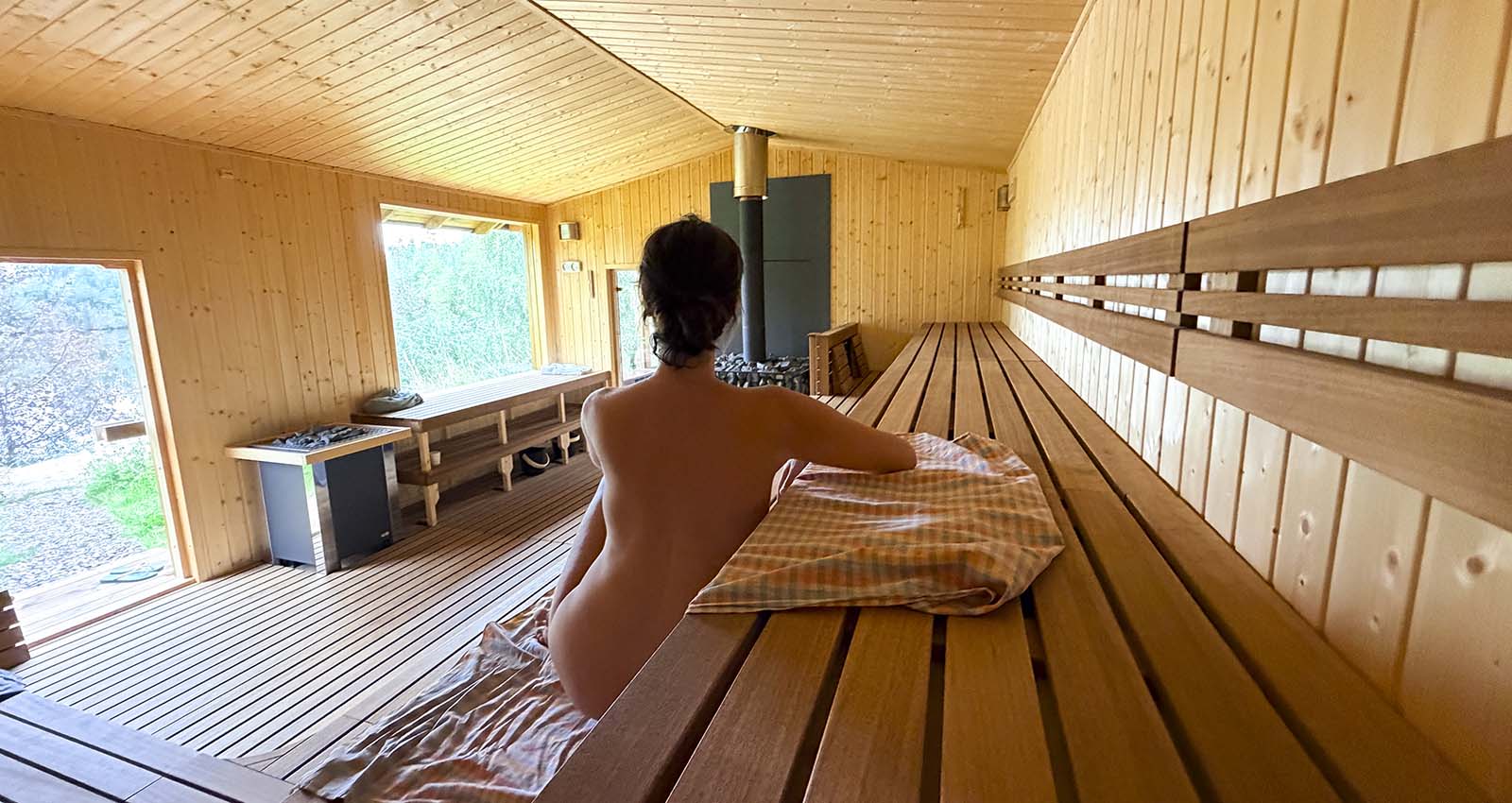
To many, social clothes-free experiences can roughly be divided into three categories. There are the nude beaches, the resorts, and events or activities. In parts of north-eastern Europe, however, there’s a fast-growing fourth category: Sauna and spa centres.
When we were planning our summer travels through northern Europe, we realised quickly that the sauna culture should be an important element of this trip. We wanted to discover how it’s organised, how nude it is, how it matches with our previous experiences, and probably the most important: How it’s different from what we know.
What we know: Belgium, Germany, and the Netherlands
Public saunas became a thing in Germany around the mid-nineteen hundreds, and throughout the decades that followed, they turned into “Mega Thermen” complexes. This trend travelled towards the Netherlands just before the start of the new millennium, and not much later these complexes started popping up in Belgium as well.
If you’ve never been to a mega thermen complex before, the best way to imagine them is by remembering a waterpark you once visited. Got one? Now replace all the slides with a variety of saunas and hammams. Put a few truckloads of sunbeds next to the pool. Add a few jaccuzzis. The wild water track can stay, but turn the power of the jets down a few notches, so they massage your body instead of pushing it away. Talking about massages, add a handful of massage rooms staffed with licensed therapists. And lastly, think away 95% of the children and 100% of the bathing suits.
This should give you a rough idea. A thermen complex is basically a waterpark that you visit to relax and improve your mental and physical health instead of burning off your energy. Nudity is usually the norm (except on specific bathing suit days), but you’re not pushed to be naked as much as possible. In between the facilities, it’s totally fine to cover up with a towel, sarong, or even a bathrobe.
This is the big difference with typical naturist places where the mantra is often “nude when possible, clothed when necessary”. Thermen are not about social nudity. Instead, nudity is used as a way to enhance the experience and for hygiene reasons (aka keeping the filters clean). Because of this, these thermen typically attract a large crowd that doesn’t call themselves naturists or nudists and may never visit a nude beach or resort.
For us, a visit to one of these complexes usually meant at least half a day, and often a full day of total relaxing. Away from our phones and from the outside world, in this warm cocoon where hours pass by reading, sweating, swimming, napping, and sipping from a glass of wine.
Clothing-optional in Denmark
We had read about the sauna traditions in the Nordic countries and also about the nude-friendly culture in Denmark, but we had no idea how these would match. Until one day we stayed at a textile campground in the north of the country that happened to have a sauna.
Partly out of curiosity, but much more because we don’t feel much for going into a sauna in a bathing suit, we asked the owner about the sauna’s dress code. He just shrugged and said, “Whatever you want”. Just to be clear, we asked if it was okay to be naked in the sauna. He gave us a strange look and repeated “Whatever you want”.

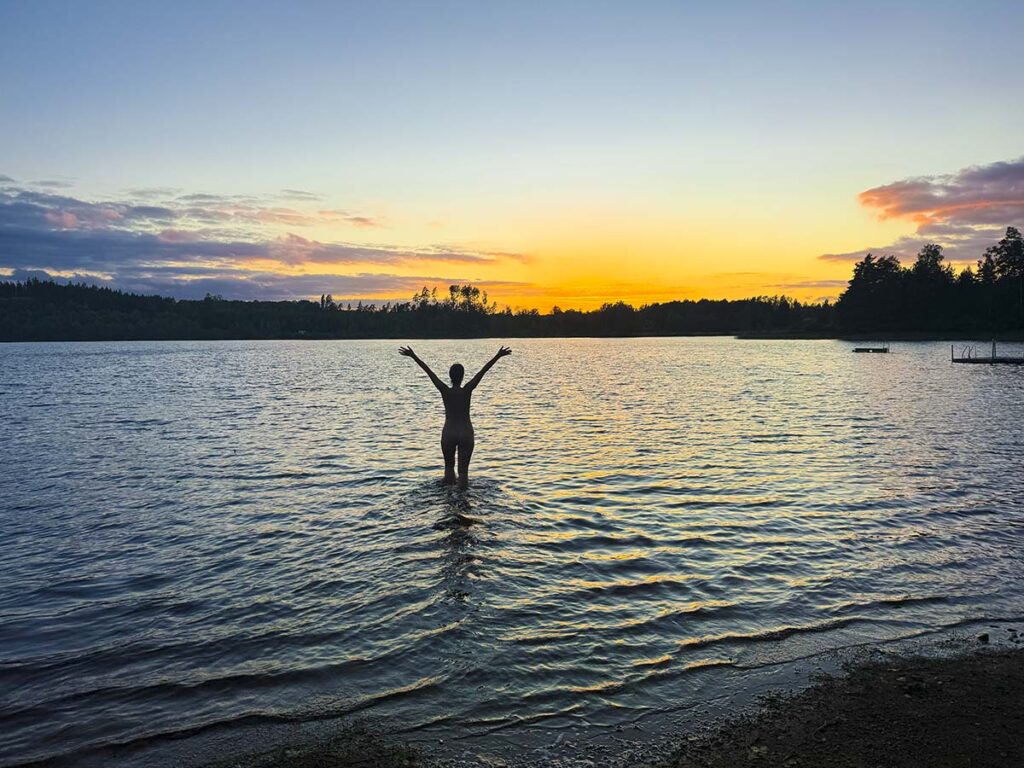
When we showed up at the sauna around sunset, it was exactly as the man had said. We were naked, another couple was naked, and a father with his two children were in bathing suits. No awkwardness from either side. Later, we would learn that this applies to many things in Denmark. Personal choices are valued a lot and are not something people are judged on.
Sweden: Where the sauna becomes the bar
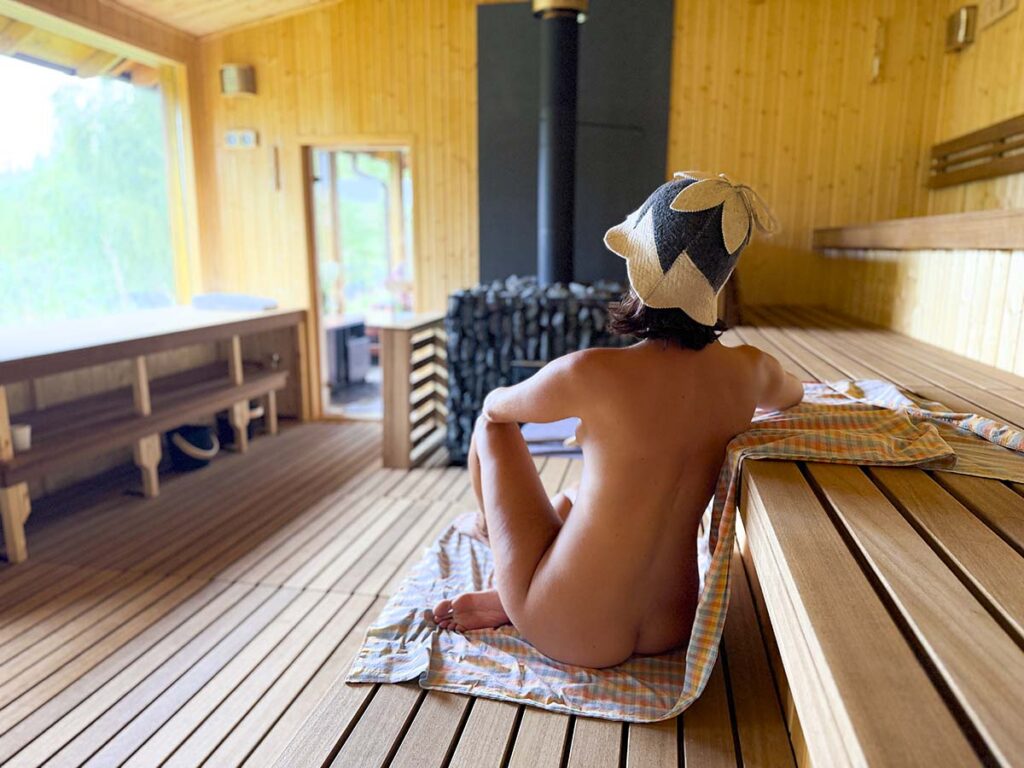
In Sweden, often considered one of the motherlands of sauna culture, we had three very distinct experiences. One was at the naturist campsites we visited, where a few sessions in the sauna are part of everyone’s evening ritual. Given the climate, this felt very natural. You have dinner around 6 PM, when the sun is still out and you can comfortably dine outside. By the time it gets chilly, you move towards the sauna.
The big difference with other places though, is that these saunas were very social spaces. The best way to describe them is like a local bar, where the actual bar is missing, tables and chairs are replaced by wooden benches and the thermostat is stuck on Extremely High. But the vibe is almost the same. People are talking, laughing, getting to know each other, and… drinking.
When we told the stories about sipping beers and cocktails in the sauna in other countries, people would shake their heads in disagreement and tell us about how this is not the way one is supposed to enjoy a sauna. But in Sweden, that’s exactly what everyone did. At the naturist campsites at least, we didn’t go to enough other saunas to know if this is actually a general Swedish thing or just a Swedish naturist thing. The reason why we didn’t visit more other saunas is that we couldn’t go together.
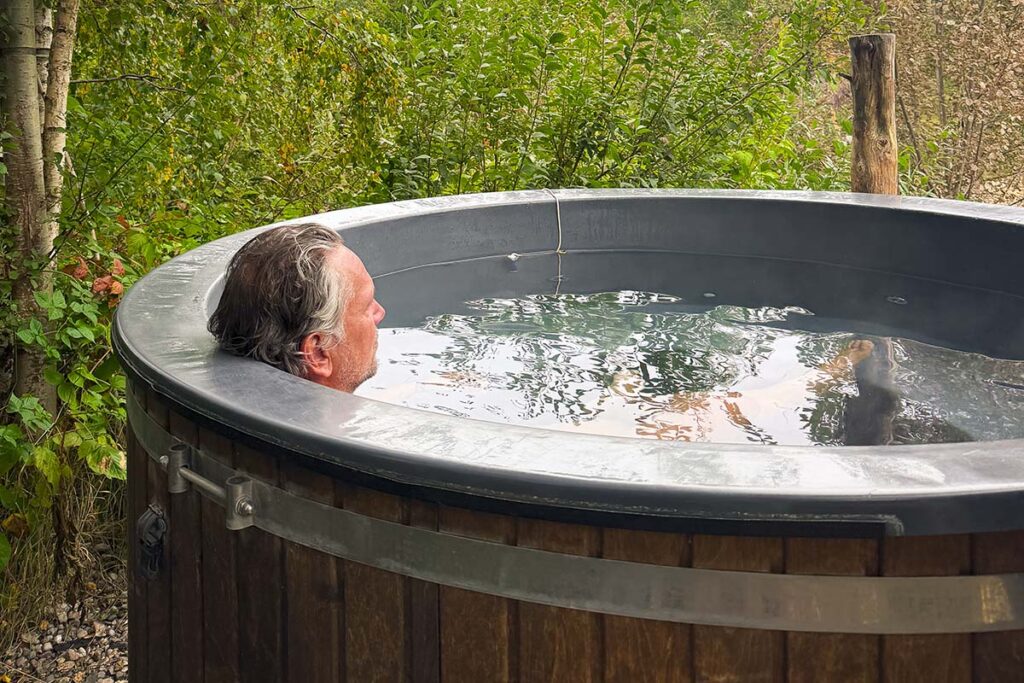
Gender separated saunas
A sauna complex in Sweden is called a “kallbadhus”. One could say that these are the smaller version of the thermen complexes, but what differentiates them is that the kallbadhus is typically gender-separated. Either they have different sections for men and women, or they work with male and female days.
According to our research, the Swedish sauna culture has existed for many centuries and was usually practised at home. Many of the Swedes were farmers and just had a family sauna on their farm. But during the Industrial Revolution, many Swedes moved towards the cities, where they had to live in smaller spaces, often without decent plumbing. So communal saunas became a thing, but since these were Victorian times, it was decided that strangers of the opposite sex would not be put together naked in a confined space. This is in big contrast with Germany, where the sauna only became popular much later and was heavily pushed by the FKK movement.
We would find something similar in the Baltic countries, where Lins visited a sauna in Riga, the capital of Latvia, during a women’s day. Other than in Sweden, the sauna tradition in the Baltics isn’t just about spending a few minutes sweating. It’s a whole process of rubbing yourself and each other with salt, minerals, and honey and of whisking and getting whisked with branches. As this is a rather active process, it actually made sense that a lot of people feel more comfortable being only around the same gender.
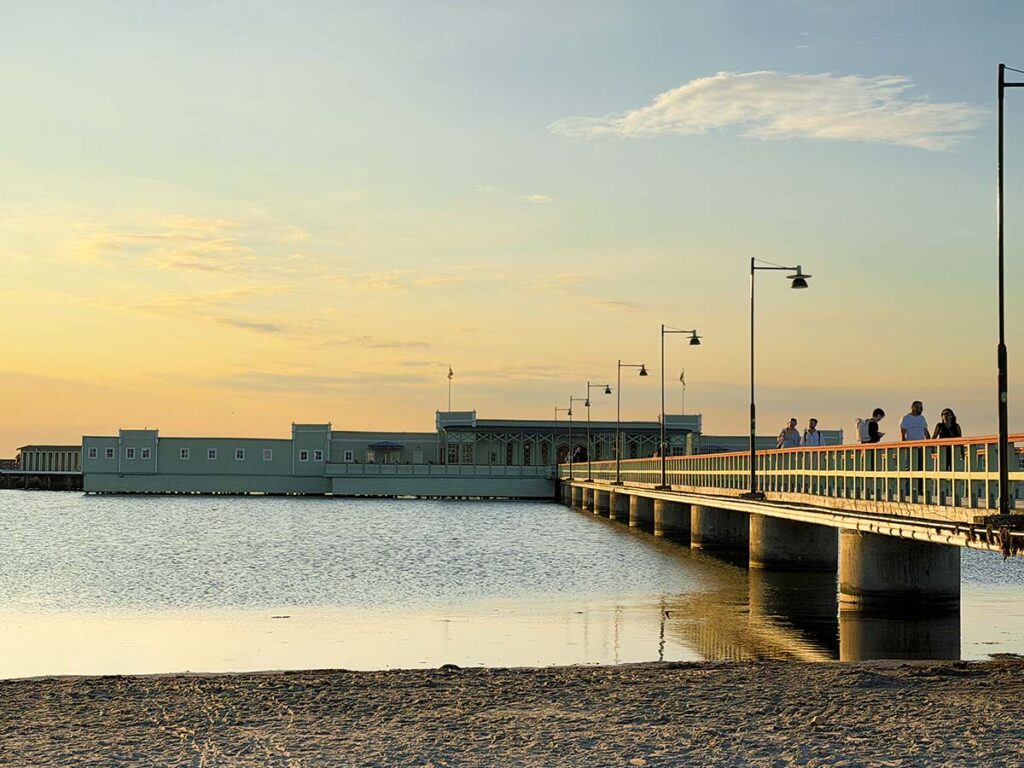
Anyway, so the kallbadhus in Sweden is typically gender-separated, but some organise “mixed days” one or more times per month. And we happened to be in Malmö exactly when the local kallbadhus had a mixed day.
The practical element of sauna
After the drinking and being separated by gender, the third reason why Swedish saunas felt very different to us was the actual experience.
Entry to the Malmö kallbadhus costs about 9 euros for the day, which is a real bargain. In Germany, Belgium, and the Netherlands, you can count on paying at least five times as much. So we packed for an afternoon (and potentially an evening as well) of full relaxation. About an hour and a half later, we were back on the street.
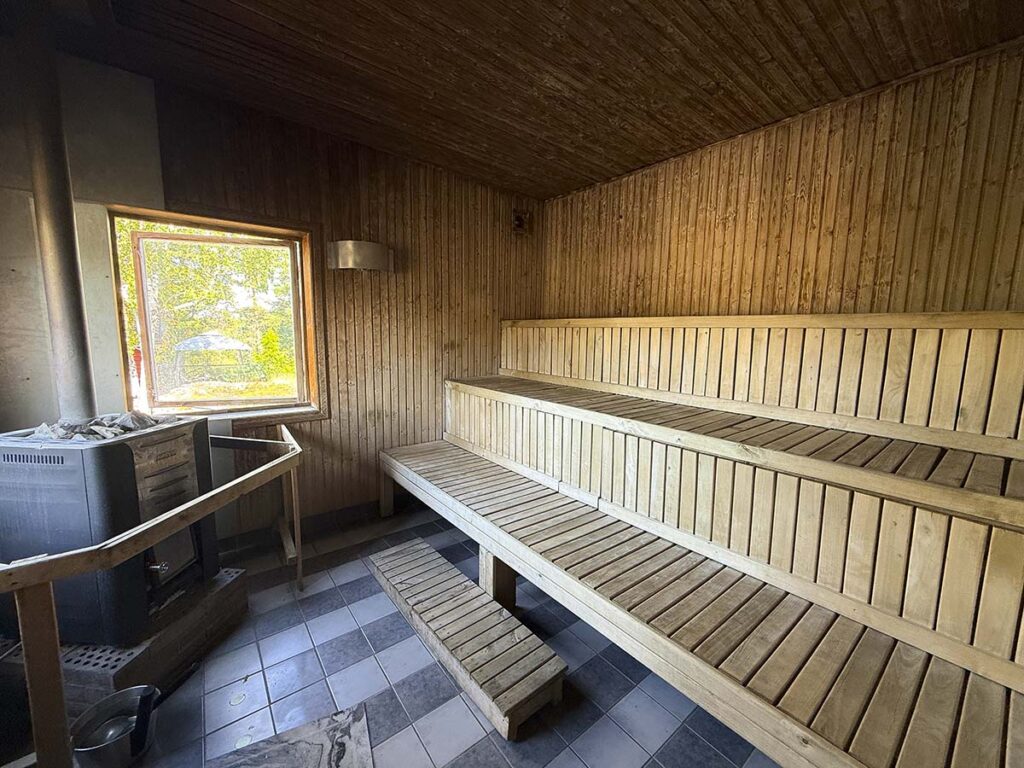
Malmö’s kallbadhus is a wooden structure built on stilts over the sea, and although it looked impressive from the outside, it appeared quite a bit smaller once we were in. This is mostly because it’s divided into two identical sections, one for men and one for women, and on mixed days, you just go together into one section. There were four saunas with different temperatures and scents and direct access to the sea to cool down. But that was it. No sunbeds, no jacuzzis, no comfy chair to doze away.
Given the constant coming and going, we realised that even though you can technically stay for the whole day, that’s not what people do. You come to the kallbadhus to enjoy the sauna, and once you’re finished, you leave.

Later, in a place called Termy Maltańskie in Poland, we noticed a very similar thing. Even though this complex looked a lot like the thermen we are used to, with many saunas and hammams, pools, jacuzzis, and whatnot, there were almost no relaxation areas. Most visitors just bought a ticket for a few hours, moved from a sauna into a hammam into another sauna and then left again.
Deep into Estonian sauna culture
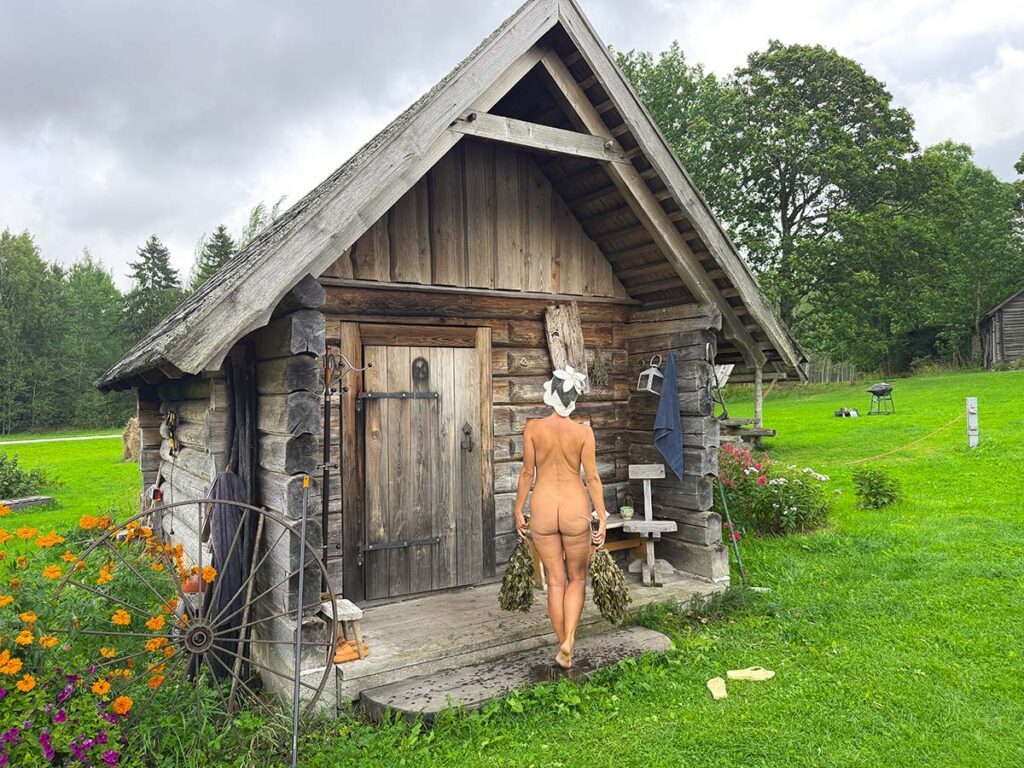
Of all the northern European countries, Estonia may have the deepest-rooted sauna culture. It’s a long-lasting tradition interwoven with ancient folklore and holistic wellbeing. Especially the “smoke sauna” stands out, which is considered a sacred ritual for cleansing both body and soul and is recognised as UNESCO heritage.
Nothing against the UNESCO organisation, but unfortunately, their great work also often results in a flow of overpriced tourist traps. We did a lot of research trying to figure out which sauna place to choose for a true, genuine experience, but as this was our first time ever in Estonia, it wasn’t much more than a wild guess. The price tag added to our worries: 250 euros for an evening. It smelled like a scam, but still it looked like our best option.
Much of our doubt went away when we arrived on a farm in the middle of Estonian countryside and were greeted by a woman who didn’t speak a word of English. In the distance, we saw her husband get off his tractor and walk towards us. He would be our sauna master, and whose English was good enough to explain what we were about to experience.
A smoke sauna requires a lot of preparation. The sauna itself is basically a wooden cottage with a big wood-fired stove in the middle and typical sauna benches around it. The stove doesn’t have a chimney, and for about 8 hours, the fire is continuously loaded with wood while the whole cottage heats up and fills with smoke. Only half an hour before the sauna is considered ready, a window is opened so the smoke goes out while the heat and the smell remain.
Throughout the day, the sauna master has also been preparing whisks with branches of different trees for different smells. He prepared buckets of water with different smells, pots of salt and honey, and probably more things that we didn’t realise at the moment. Long story short, when we arrived around 6 PM, our sauna master had already spent a whole day preparing. And his work was not yet done, on the contrary.
For the following hours, our sauna master would lead us through the different phases of the sauna ritual. The sweating and breathing, the rinsing and whisking, and finding the mental state in which you can actually endure these very high temperatures for more than a few minutes (which definitely didn’t always work). In total, this process would take about 5 hours until we were exhausted enough to go straight to bed.
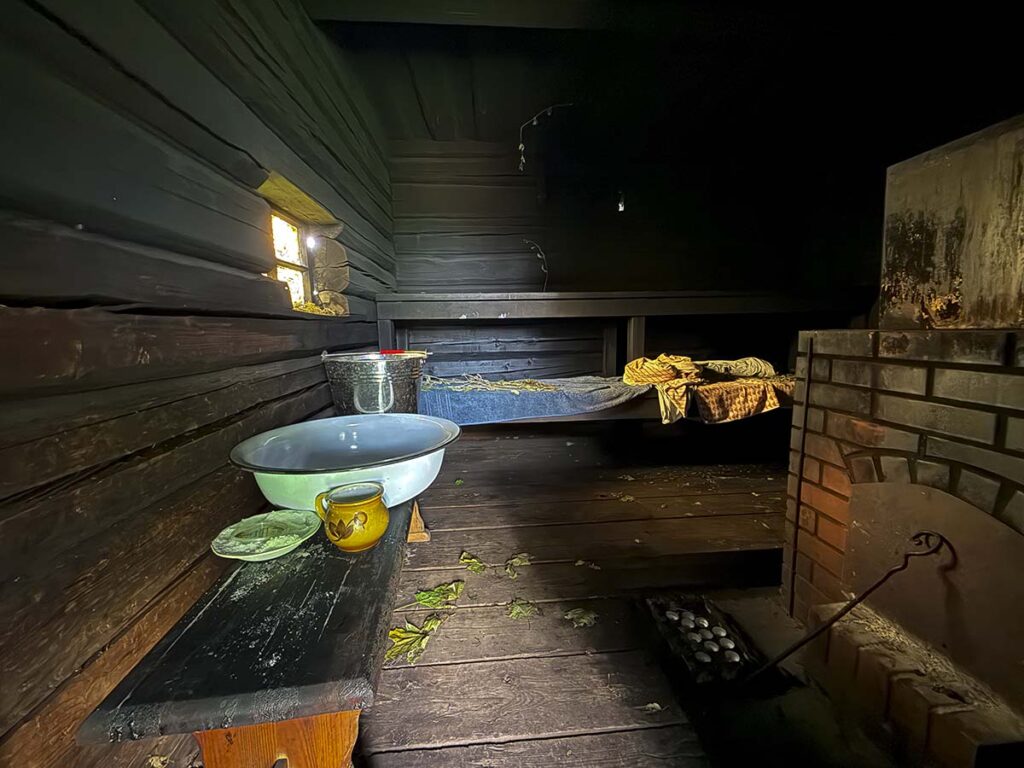
The next morning, we went back into the sauna to take some pictures and noticed the mess we had made. There was water and salt everywhere, leaves from the whisking branches, and mud which our feet had picked up while we had been standing in the cold pouring rain the night before to cool down. While we would continue our journey talking about this amazing experience, our sauna master would spend at least another few hours cleaning up. 250 euros were definitely justified.
Sauna as an experience
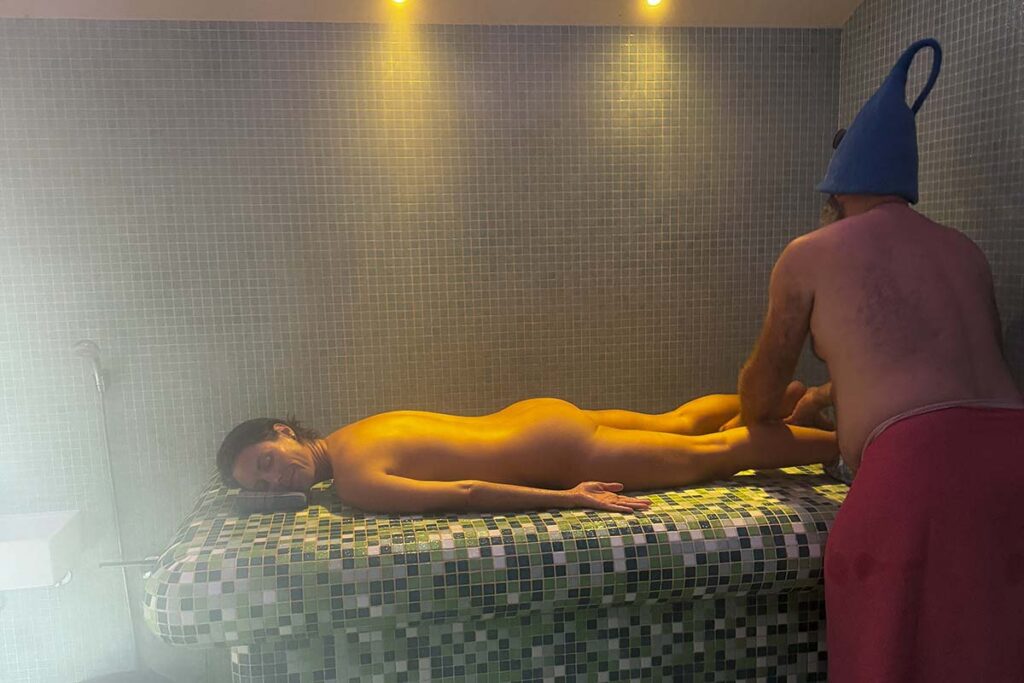
If you’ve ever been to a European thermen complex and at one point noticed a long queue at a certain sauna, that’s probably because an aufguss session was about to start. For many sauna enthusiasts, the aufguss is the highlight of their visit.
Aufguss (German for “pouring on”) is a sensory ritual in which the sauna master pours scented water on the hot stones and then waves with a towel to spread the heat and scents. This originates from German-speaking Europe and started as a simple method to increase heat and humidity, but along the way evolved into an art form. There’s always music involved, and sometimes you’ll find the sauna master dancing or juggling with the towels. During aufguss festivals or competitions, you may even see several sauna masters performing pieces of theatre during their 10- to 15-minute act. Just to say that this is not just about spreading the heat, it’s an experience.

One of the best places where we enjoyed this was at Saunowy Staw in northern Poland. Compared to Germany’s thermen complexes, Saunowy Staw isn’t all that spectacular. It’s a small lake surrounded by several wooden cottages where you can find three saunas and a hammam. Additional is an indoor relaxation area and two outdoor hot tubs.
What makes Saunowy Staw stand out though, is that they completely focus on the experience. This is not the kind of place where you arrive and leave as you please. Instead, they work with two 2.5-hour slots per day, in which a variety of sauna sessions are planned. Since everyone arrives at exactly the same time and groups consist of no more than 40 or 50 people, from the very beginning, you feel as part of a community. Even we, who don’t speak a word of Polish.
We’ve joined three of these two and a half hour periods and don’t recall seeing a single person not participating in one of the sauna sessions, which were all with aufguss by default. The fact that this place also does sauna master courses is probably why they have enough sauna masters available for several sessions, twice per day.
Nudity in the sauna culture
At Saunowy Staw, nudity is mandatory inside the facilities, but we noticed that many decided to cover up with a sarong or towel in between sessions. In Termy Maltańskie, also in Poland, we had seen the exact same thing. Many would even cover up for the five steps from the sauna to the shower.
Just a bit up north, at the sauna complex of Druskininkai in Lithuania, which is clothing-optional, we had been the only ones who had chosen the no bathing suit option. In Malmö kallbadhus, on the other hand, nudity is obligatory by default, but on mixed days they make an exception, and the place becomes clothing-optional. Yet every single piece of fabric that wasn’t a towel stayed in the dressing room.
In the smoke sauna, our sauna master had always been wearing his “sauna costume” until after the rituals were finished and he joined us nude. We don’t know whether this had anything to do with the tradition or if it just took him a while to feel comfortable enough to be naked with us. It felt inappropriate to ask at the time.
We ended our summer journey in Kristall Wohlfühltherme Ludwigsfelde, just south of Berlin in Germany, and it felt like coming home. This was what we have known for a long time. A place where people come to spend a day relaxing, with nudity all around.
After travelling through seven countries where sauna is somehow baked into the culture, probably the most interesting thing to see was how local habits, traditions and history completely shaped the experience into something unique, time and time again.
Support Naked Wanderings
Do you like what we do for naturism and naturists?
Did we make you laugh or cry?
Did we help you find the information you were looking for?
Then definitely join our Patreon community!